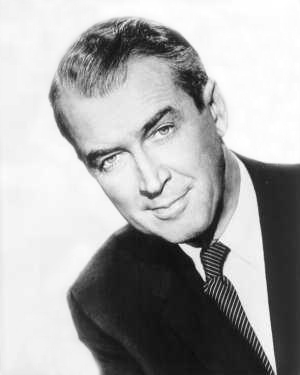
James Stewart's Biography
Date of Birth: May 20, 1908
Birthplace: Indiana, Pennsylvania, U.S.A.
Date of Death: July 2, 1997
Place: Los Angeles, California, U.S.A.
Cause of Death: Cardiac arrest & Pulmonary blood clot
James Stewart was one of the most trusted and beloved of American actors, a star who now arouses great public affection chiefly because of his comedies, "It's a Wonderful Life," and his artful hesitation in talk shows towards the end of his life. His body of mature films, made during the 1950s for Hitchcock and Anthony Mann, while generally presenting him as a troubled, querulous, or lonely personality, clearly play on the immense reputation for charm that his early films had won. Stewart is one of the most intriguing examples of a star cast increasingly against his accepted character. The emotional subtlety of films like "The Naked Spur," "Rear Window," "The Far Country," "The Man from Laramie," and "Vertigo" derives from the way in which we are intrigued by the contradictions in Stewart himself, between hardness and vulnerability.
Growing Up
In keeping with family tradition, Stewart entered Princeton University in New Jersey in 1928, where he became a member of the Princeton Triangle Club and appeared in their musicals. Although he studied architecture, even before he earned his degree in 1932, Stewart knew he was more interested in acting. After graduation, he headed for the University Players, a theater group in Falmouth, Massachusetts, where he met another soon-to-be-great-film-star, Henry Fonda. They would become lifelong friends even though they had differing views on many subjects. Lacayo noted that Stewart and Fonda "stayed close by agreeing never to discuss politics."
Stewart first stepped on a Broadway stage in October 1932, in the unsuccessful "Carry Nation." Two months later he had two lines as the chauffeur in "Goodbye Again." But in 1934, Stewart landed a sizeable role in the story of Walter Reed's battle against yellow fever in "Yellow Jack," playing the role of Sergeant O'Hara. He received positive reviews for this role, but the play did not do well.
After five more stage appearances, Stewart took a train to Hollywood, where he roomed with Henry Fonda who had settled there earlier. An MGM talent scout, Billy Grady, had seen his work and got the studio to cast him in "Murder Man," in 1935. Stewart later said he was awful, but over the next five years he made 24 movies, including Frank Capra's 1938 film "You Can't Take It With You," which won the Academy Awards for Best Picture and Best Director. He then portrayed the idealistic young senator in "Mr. Smith Goes to Washington" in 1939, for which Stewart won the New York Film Critics Best Actor award and an Academy Award nomination. In 1940, he was in "The Philadelphia Story" with Katharine Hepburn and Cary Grant, and won the Best Actor at the Academy Award for his performance. His Academy Award was sent home to Indiana to be displayed in the family hardware store.
World War II Era
Stewart's career was taking off when World War II gave him a new role as a pilot. Having some flying experience, he joined the United States Army and was assigned to the U.S. Army Air Corps in 1941. According to Lacayo, "Stewart was rejected on his first physical for being 10 pounds underweight, an embarrassment that made headlines around the country.... Just days after winning the Oscar, Stewart took his second physical. This time he made it, but barely." After some time as an instructor, he was sent to Europe as commander of a bomber squadron in November of 1943. He was awarded the Air Medal and Distinguished Flying Cross and reached the rank of brigadier general in the Air Force Reserve in 1959.
His first movie after the war was "It's a Wonderful Life" in 1946. Although the movie was not a success at the box office, it has since become a holiday classic. Audiences still enjoyed Stewart and related to the depressed, down-on-his-luck George Bailey. Lacayo noted that Stewart's "speaking voice seemed to spring from an ideal American center, both geographic and spiritual, a place of small towns and unhurried people." According to those who knew him, these qualities on screen were part of the real person. From then until his last two films, a television movie "Right of Way" with Bette Davis in 1983 and an animation film entitled "An American Tail: Fievel Goes West" in 1991, Stewart's popularity never waned.
A Wonderful Life for Jimmy
In 1949, Hollywood's most eligible bachelor, Stewart (at age 41), married Gloria Hatrick McLean. In a town where marriage and divorce are not considered front page news, the Stewarts managed one of Hollywood's most durable and happy unions. The family included four children, sons Ronald and Michael from his wife's first marriage, and twin girls Judy and Kelly, born in 1951.
As Stewart aged, he kept many of the screen mannerisms of his youth, but they were displayed in a more mature, confident demeanor that audiences responded to. His long and varied career includes some audience and critic favorites: "Call Northside 777" (1948); "Harvey" (1950), in which he plays a drunk whose friend happens to be a giant, invisible rabbit (Stewart returned once to Broadway for this role in 1947); bandleader Glenn Miller in "The Glenn Miller Story" (1953); pilot Charles Lindbergh in "The Spirit of St. Louis" (1957); the Alfred Hitchcock thriller "Vertigo" (1958); and a number of well-received Westerns, including "Winchester `73" (1950), "Bend of the River" (1952), "The Man From Laramie" (1955), and "The Man Who Shot Liberty Valance" (1962). Some critics did not know how to react to an unshaven Stewart playing a rough and tumble cowboy, but the audiences didn't mind. For his 1959 role as the defense attorney in "Anatomy of a Murder," Stewart won the New York Film Critics awards as well as honors from the Venice Film Festival.
When Stewart played the quiet, confident American hero, audiences felt he was pretty much playing himself. In 1955, he was a baseball player recalled to the air force in "Strategic Air Command," opposite June Allyson with whom he played in a number of films. Stewart often liked to work with the same actors or directors. He was also considered to be a good businessman.
In his later years, Stewart worked steadily into the 1970s, even trying his luck with two television series. He never quite lost the boyish charm that had caught the eye of a movie agent back in the 1920s. Graying and still soft spoken, he was always a welcome guest on television late night shows where he delighted audiences with Hollywood stories and sometimes bad poetry. Taking his anecdotes a step further, he had a best selling book, Jimmy Stewart and His Poems, which was published in 1989. He also received an Honorary Academy Award in 1985 for, as the Academy noted, "his 50 years of meaningful performances, for his high ideals, both on and off the screen, with the respect and affection of his colleagues."
An Actor We Will Never Forget
After a 45 year marriage, Gloria Stewart passed away in 1994. In 1995, Stewart was honored when "The Jimmy Stewart Museum" opened in his hometown. Yet, Stewart was said to be distraught after the loss of his wife. Former co-star Shirley Jones commented to People "Gloria's death was a shock he never got over." Stewart died on July 2, 1997, at his home in Beverly Hills, California. As Ansen of Newsweek reflected, "It's nice to remember a world when a movie star was also a gentleman." Added Terry Lawson of the Detroit Free Press, Stewart's "shy stutter, every-guy charm, and extraordinary range of classic film roles made him one of the most loved and admired of all American actors."